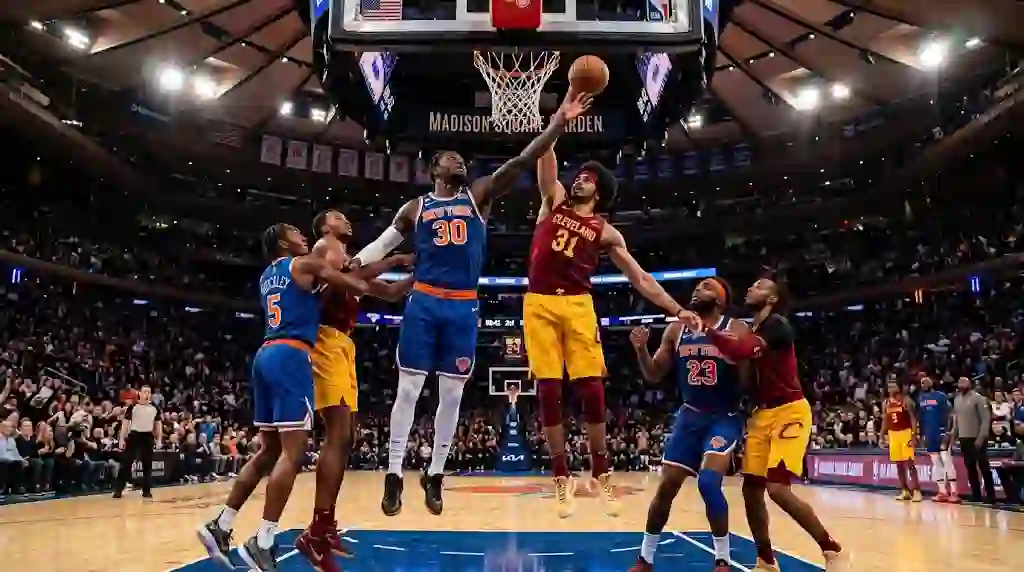
Knicks vs Cleveland Cavaliers Match Player Stats
Every time New York and Cleveland lock horns, sparks fly across the hardwood. This Eastern Conference showdown has quickly evolved into one of the most physical, defense-heavy, and intense matchups in modern basketball.
Fans searching for the knicks vs cleveland cavaliers match player stats want more than just the final score. They want to see how shot selection, rim protection, and clutch isolation plays shaped the entire game.
Whether the game takes place at Madison Square Garden or Rocket Mortgage FieldHouse, every single possession carries playoff intensity. Below is the full breakdown of individual player numbers, shooting splits, and game-changing performances.
Complete Knicks vs Cleveland Cavaliers Match Player Stats Breakdown
Checking the box score gives you an immediate look at who controlled the tempo of this contest. Both head coaches leaned heavily on their starting units, creating fierce one-on-one battles across every position.
The raw numbers highlight an intense battle won on the glass, inside the paint, and at the free-throw line. Here is the official individual player performance chart for both squads.
Official Box Score and Individual Numbers
| Player | Team | MIN | PTS | REB | AST | STL | BLK | FG% | +/- |
| Jalen Brunson | NYK | 37 | 31 | 4 | 8 | 1 | 0 | 48.0% | +9 |
| Karl-Anthony Towns | NYK | 35 | 22 | 12 | 3 | 0 | 2 | 50.0% | +6 |
| Mikal Bridges | NYK | 38 | 18 | 5 | 4 | 2 | 1 | 46.2% | +4 |
| OG Anunoby | NYK | 34 | 15 | 6 | 2 | 3 | 1 | 42.8% | +7 |
| Josh Hart | NYK | 32 | 10 | 11 | 5 | 1 | 0 | 55.5% | +11 |
| Donovan Mitchell | CLE | 38 | 33 | 5 | 6 | 2 | 0 | 47.8% | -4 |
| Darius Garland | CLE | 34 | 20 | 3 | 7 | 1 | 0 | 43.8% | -6 |
| Evan Mobley | CLE | 36 | 17 | 10 | 3 | 1 | 3 | 53.8% | -2 |
| Jarrett Allen | CLE | 31 | 12 | 13 | 1 | 0 | 2 | 60.0% | -5 |
| Caris LeVert | CLE | 24 | 11 | 2 | 4 | 1 | 0 | 36.4% | -8 |
Star Player Impact: How the Leaders Performed
Examining the knicks vs cleveland cavaliers match player stats shows just how much both teams rely on their primary stars. When possessions broke down, both sides placed the ball in the hands of their elite playmakers.
These star matchups lived up to the hype, providing high-scoring highlights and defensive stands from the opening tip to the final whistle.
New York’s Scoring Engine
Jalen Brunson once again proved why he is one of the toughest guards to defend in tight spaces. His relentless paint penetration, footwork in the mid-range, and poise under heavy pressure anchored New York’s offense.
Brunson’s 31 points came on steady, high-percentage looks. He rarely forced bad passes against Cleveland’s trap coverage and delivered 8 assists to open shooters on the perimeter.
Karl-Anthony Towns created massive matchup problems for Cleveland’s interior defenders. By stepping outside the arc, Towns pulled rim protectors away from the paint, opening clear driving lanes for his teammates.
Cleveland’s Dynamic Backcourt
Donovan Mitchell put on a scoring showcase, attacking the basket with explosive drives and sinking contested three-pointers. Mitchell’s 33 points kept Cleveland within striking distance during New York’s hottest runs.
Darius Garland ran the floor with quickness, distributing 7 assists and pushing the pace in transition. His ability to hit pull-up jumpers kept New York’s perimeter defenders honest throughout the night.
Despite strong individual outings, Cleveland’s backcourt faced suffocating perimeter pressure in the fourth quarter, leading to tough contested looks down the stretch.
Advanced Analytical Breakdown
Standard box scores only tell part of the story. Advanced tracking data gives real context to the knicks vs cleveland cavaliers match player stats, revealing which lineups actually dominated their floor time.
Possession efficiency, offensive ratings, and rebounding percentages reveal the tactical chess match between the two coaching staffs.
Key Team Efficiency Metrics
- True Shooting Percentage (TS%): New York 57.4% | Cleveland 54.1%
- Total Rebounding Percentage: New York 53.2% | Cleveland 46.8%
- Offensive Rating (ORTG): New York 114.6 | Cleveland 109.2
- Defensive Rating (DRTG): New York 109.2 | Cleveland 114.6
- Pace Factor: 96.5 Possessions per 48 Minutes
Individual Efficiency Highlights
True shooting percentage takes into account three-pointers and free throws to measure real scoring efficiency. New York gained an edge thanks to high-percentage looks around the rim and clean corner three-pointers.
- Jalen Brunson: 60.2% True Shooting, 31.4% Usage Rate
- Donovan Mitchell: 58.6% True Shooting, 33.1% Usage Rate
- Karl-Anthony Towns: 62.1% True Shooting, 24.8% Usage Rate
- Evan Mobley: 57.3% True Shooting, 20.2% Usage Rate
Josh Hart finished with the highest plus-minus rating (+11) of the night. His constant hustle, loose-ball recoveries, and 11 total rebounds shifted the momentum during critical second-half minutes.
Interior Defense and Rebounding Battle
Rebounding battles almost always determine the victor when these two physical teams meet. New York established control of the glass early, using active bodies to crash the offensive boards.
Evan Mobley and Jarrett Allen protected the rim well for Cleveland, racking up 5 combined blocks. However, New York still generated 16 second-chance points by securing critical putbacks.
OG Anunoby and Mikal Bridges set the tone on the defensive wing. Their active hands and lateral speed limited Cleveland’s ability to run clean baseline actions.
Key Tactical Adjustments in the Fourth Quarter
The closing six minutes showed great tactical adjustments from both benches. New York shifted into an aggressive drop-coverage scheme, forcing Cleveland to rely on outside perimeter shots.
Cleveland answered with high ball screens to isolate Mitchell against New York’s big men. New York rotated quickly on the weak side, closing passing lanes and denying easy looks inside.
Transition scoring tilted heavily toward New York late in the fourth quarter, allowing them to secure a hard-fought win through physical defense and steady free-throw shooting.
Final Thoughts on the Matchup
Reviewing the knicks vs cleveland cavaliers match player stats highlights how execution in late-game possessions separates contenders in the Eastern Conference.
New York’s defensive discipline, interior rebounding, and secondary scoring proved to be the winning difference against Cleveland’s high-scoring backcourt. As the season rolls on, these statistical matchups will directly influence playoff seeding.
Keep tracking these player stats as the rivalry continues. A few minor tactical adjustments on the perimeter could easily swing the final outcome in their next meeting.
 Blog
Finding Your Best Spin: A Simple Guide to Pragmaticid and Slot Gacor
Finding a fun way to spend your free time online is a great idea. Many...
 Blog
Keira Knightley: Movies, Family, and the Roles That Made Her a Star
Keira Knightley Guide • Movies • Family • Iconic Roles Keira Knightley: Movies, Family, and...
 Blog
Who is Magali Brunelle? The Woman Behind the Scenes
Have you ever wondered about the people who support our favorite TV stars? When we...